The race for European grants: rising competition, falling success rates
Any questions about this topic?
Do you have any questions about this aritcle or would you like to contact the author?
The European Union is a crucial source of funding for innovation. For example, for fundamental research by excellent researchers via the ERC, but also for disruptive and groundbreaking innovations via the EIC. However, preparing an application for these programmes requires a lot of time and effort. Recent research even shows that, on average, the costs of applying are higher than the benefits. In addition, the chances of success are structurally declining. Why is this happening, and how do we deal with it?
Declining success rates for EIC, ERC and Eurostars
Although the European Innovation Council (EIC) and European Research Council (ERC) increase their budgets annually, they again reported a record number of applications last year. Competition is increasing faster than the available resources. This translates directly into declining success rates:
| EIC programme | Success rate 2024 | Success rate 2025 |
| Pathfinder Challenges | 7,7% | 4,8% |
| Pathfinder Open | 4,1% | 1,8% |
| Transition | 10% | 6,6% |
| Accelerator Open | 6,4% | 5,6% |
| ERC programme | Success rate 2023 | Success rate 2024 |
| Starting grant | 14,8% | 12,2% |
| Consolidator grant | 14,5% | 14,2% |
| Advanced grant | 13,9% | 11% |
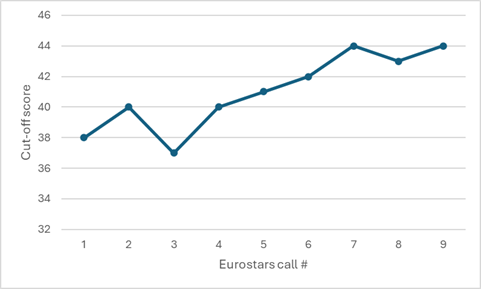
We see a similar picture with the Eurostars grant. After an initial assessment by external experts, only the highest-scoring proposals proceed to a second round, in which they are assessed by an independent evaluation panel. Due to increasing competition, the cut-off score for reaching this second round is getting higher and higher:
More investment is a necessity
What is the most important structural solution? More budget for research and innovation in Europe. In a changing geopolitical context, the EU and its Member States will have to operate more and more independently. Investments in research and innovation within Europe are essential to strengthen technological competitiveness against countries such as the United States and China.
Selection starts before the application
In addition, there are significant gains to be made at the level of the individual applicant. Early, honest and concrete advice on the feasibility of a project can save a lot of time and resources. Not every idea is viable within a European grant programme. Sometimes an early “no” is the most valuable support an applicant can receive.
Success requires excellence and persuasive power
If the feasibility is assessed positively, a strong plan remains the most important success factor. Excellent research, carried out by a strong and interdisciplinary consortium, with convincing scientific, economic and societal impact. It is equally important that this potential is communicated clearly and credibly to the assessors, and that weaknesses are identified and mitigated at an early stage.
Increase your chances in Europe with Hezelburcht
Hezelburcht adds value to all these steps, from feasibility assessment to plan development and writing the application. We have extensive experience in supporting European grant applications for a wide variety of clients: from knowledge institutions to companies, and from young start-ups to large multinationals.